By Karyn Lee Greig
On 4th February I attended the one-night-only performance of ‘A Worthy Rival’ at the Victorian Pride Centre. In the spirit of the Australian Women’s Open that had finished a week earlier, this new script revolves around two leading female tennis players vying for that top prize.
The playwright, Demetra Giannakopoulos is a multi-disciplinary artist – a writer, director and film maker who, as a proficient tennis player herself, goes with her passions. Her film production company, Idolon Films, explores stories that ‘communicate ideas that help us understand the world around us, understand each other, and ourselves’. This work, A Worthy Rival lets us into the psychological challenges of being a top tennis player where ‘rivals’ can actually make you better at what you do. In the words of Billie Jean King, ‘pressure is a privilege’ where, you have, in the words of Rudyard Kipling, the opportunity to ‘meet Triumph and Disaster and treat those two imposters just the same’.
Giannakopoulos presents this work as a reading or audio play, for possible further development. The impressive Victorian Pride Centre in St Kilda, recently completed in July 2021, is a fitting venue for this purpose. It is also significant that this piece is part of the Midsumma festival and was presented on the eve of this year’s Pride March. This is relevant as Sam, the rookie finalist in the play, expresses her concern about how her sexual identity might be perceived by the tennis fraternity.
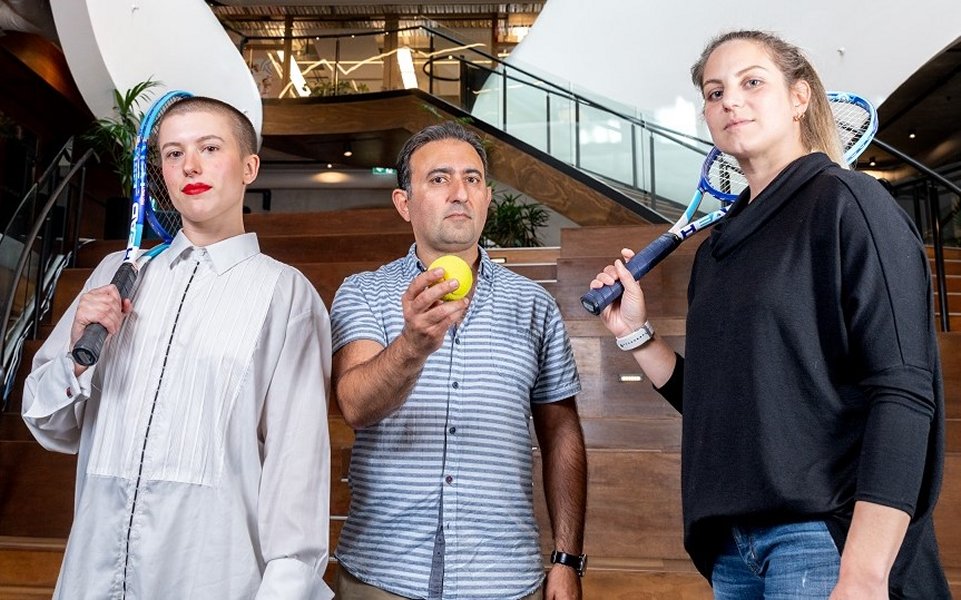
A Worthy Rival as a reading makes my head spin thinking about the directorial possibilities. It could be a radio or audio play as stated, a piece of live theatre or a film. It is a three-hander, with the two female tennis rivals: ‘Victoria’ read by Christina Rampatzi, as the experienced player and reigning champion, and ‘Sam’ read by Shannon Stevens, as the successful rookie who has risen through the ranks to compete against Victoria. The ‘Commentator’ & ‘Journalist’ in turn are read by Amir Rahimzadeh. The piece is supported by some beautiful songs written and sung by Saint Ergo.
As an audio play, I sometimes found it difficult to ascertain where the characters were in the story, but a more developed sound design may rectify this. The whole piece moves towards the two players actually about to commence the final, which was a lovely twist at the end. The musical interludes between scenes may need to be shortened or adjusted to assist the flow of the piece.
As a live theatre piece, the location of the characters at any given time is more easily established visually. There are also the exciting possibilities for the physicality and even ‘choreography’ that could be developed to give the piece a sense of spectacle. Stage projections involving flashbacks, news sequences or reflections on the current action could be an interesting addition during prudently selected song sequences.
As a film, just about anything is possible visually – split screens, flashbacks, dream sequences – as long as the audience receives a nuanced rendition of the two leading females, avoiding clichés or generalisations, given the status difference between the two players.
So seldom have we seen a dramatic piece that focuses on women in high stakes competitive sport, particularly tennis. It is very exciting to consider how this work might be developed and where it might go.
Image:Luke David


