By Calysta Morgan
Nestled amidst the lush greenery of Central Park Malvern, Melbourne Shakespeare Company’s adaptation of “Much Ado About Nothing” transports audiences on a delightful journey through time and tradition. With a unique blend of Shakespearean wit and 60s flair, this outdoor production breathes new life into a beloved classic, captivating theatregoers of all ages.
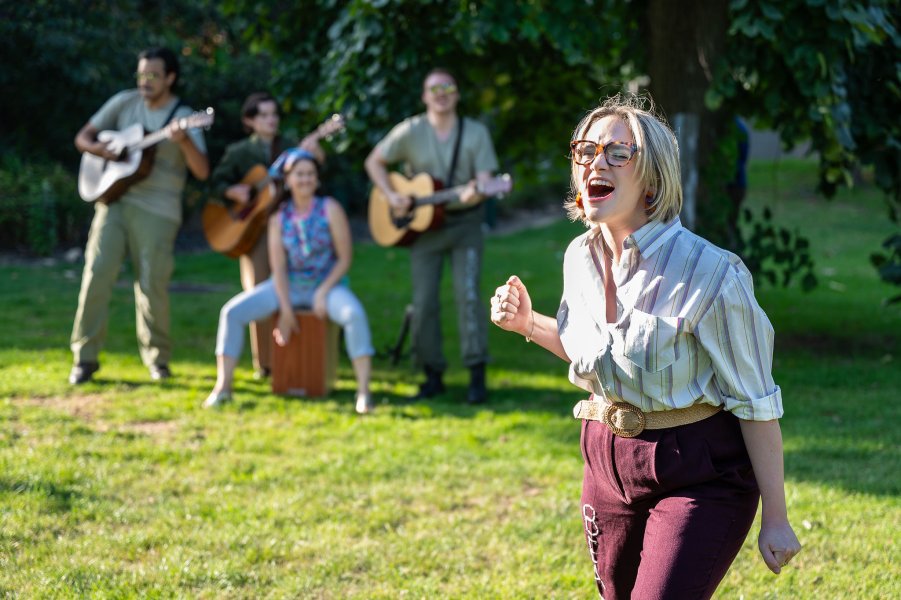
For the uninitiated, character names sewn onto costumes help keep track of the who’s-who of the show. For those familiar with the production already, Director Emma Austin’s adaptation uses informal contextualising dialogue alongside the original text. The resulting playful, improvisatory feel very much fits the relaxed performance setting and keeps us guessing as to how exactly events will be played. A particular strength of the show is the physicality and strong characterisation of the entire cast, with blocking and business – particularly the business of eavesdropping – making great use of the expansive ‘stage’ area and natural props. Recurring sight gags from Dogberry (Bridget Sweeney) and Verges (Asher Griffith-Jones) in particular had the audience in stitches, but should you be inexplicably uninterested in the main action, there is plenty more to be spied ‘backstage’ or ‘in the wings’. The entire Company was consistently engaging to watch, regardless of their role size. A personal favourite though was seeing Annabelle Tudor make short work of the gamut of emotions required for this abridged version of Beatrice – a very satisfying performance indeed.
“Much Ado’s” music and costumes place the adaptation in the 60s, although the dialogue remained fairly firmly – perhaps frustratingly so, despite masterful delivery – in the original 1500s. Natalie Calia’s pleasant musical arrangements added to the pace and emotion of the performance, often emphasising the overall joyousness of the show. The guitar and simple percussion accompaniment were both effective, and skillfully performed, with enjoyable and recognisable song choices throughout (the finale ‘megamix’ was particularly fun). Any potential issues with sound reinforcement in an outdoor non-amplified performance were neatly dealt with through the use of ensemble work and doubling of lines, both for instruments and voices. The more reflective solo performance arrangements were likewise thoughtfully supported with fewer instruments to maintain the same sense of balance. Vocal projection and enunciation from the actors were generally strong throughout, however bringing picnic blankets rather than chairs will be more likely to guarantee audience members will be seated near the front and have that same experience.
As usual with Melbourne weather, it’s best to bring both a hat, and something warm. Definitely bring a picnic, but be warned that depending on where you sit, you may have some unexpected guests of the human variety (albeit very polite ones!). Ultimately though, with its stellar performances, infectious energy, and picturesque setting, Melbourne Shakespeare Company’s adaptation of “Much Ado About Nothing” is a celebration of the enduring power of theatre to inspire, enchant, and delight.